

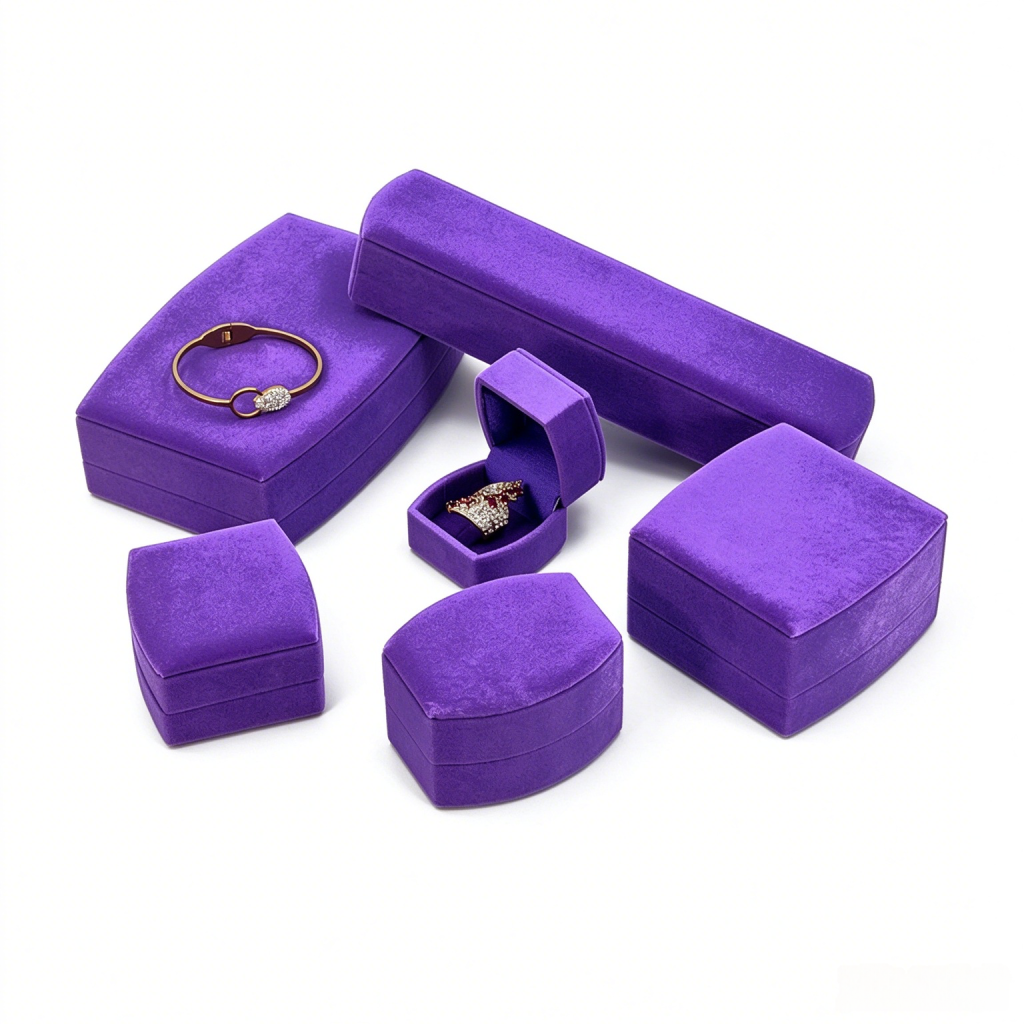
You get a jewelry box sample. The lining feels soft, looks premium. The supplier says it’s velvet. You place the bulk order. Three months later, customer complaints roll in — the lining sheds powder, fibers rub off bald, creases stay pressed in forever.
That’s not a quality control slip. The material was wrong from the start.
In jewelry packaging, electrostatic flocking and woven velvet are two jewelry box lining materials that look almost identical on the surface but sit at completely different structural levels. Buyers who can’t tell them apart at the sample stage end up either paying velvet prices for flocking, or sourcing low-grade flocking that fails in the field.
The 3 tests below are ones we use constantly in real production and client sample reviews. No lab equipment needed — you can run them at your desk in 30 seconds. Paired with a comparison table and answers to the questions buyers ask most, they’ll help you lock down jewelry box lining material before you commit to a production run.
The Core Difference: Glued On vs Woven In
Before testing, take one minute to understand what’s underneath. Every test below is just checking for this one structural difference.
| Electrostatic Flocking | Woven Velvet | |
| How fibers attach | Adhesive applied to substrate (cardboard, PVC, non-woven), short fibers (0.3–1.5mm) electrostatically charged and stood upright on the glue | Warp and weft yarns woven into base fabric; pile yarns form loops during weaving, then cut — pile is rooted in the fabric |
| Is there a base fabric? | No. Fibers are held only by glue on the substrate surface | Yes, complete woven base. Pile and fabric are one piece |
| Touch and sheen | Short, stiff, upright. Flat sheen. Fibers flatten under friction and stay down | Soft, smooth. Directional light play when brushed. Pile recovers naturally |
| How it ages | Moisture loosens glue, fibers shed. Friction causes bald spots. Creases are permanent | Abrasion-resistant. Pile slowly recovers after compression |
| Rough cost | Low — suited for high-volume, cost-sensitive packaging | Higher — mid-to-high-end jewelry box lining |
| Best fit | Fast-fashion jewelry, promotional boxes, budget packaging | Fine jewelry, engagement ring boxes, watch cases, collector boxes |
Put bluntly: flocking fibers are glued on. Velvet fibers are woven in. One is like sprinkling sand on wet paint. The other is like a carpet where the pile is part of the weave. That single difference drives everything — durability, feel, safety, cost.
Test 1: Scrape the Edge — Does It Shed?
Fastest check in the book. No tools needed.
Take your fingernail or a coin edge. Find the lining’s folded corner, wrapped edge, or slot interior — places where the wrapping process is most likely to leave adhesive exposed. Scrape with moderate pressure, 3 to 5 times.
If it sheds: The scraped area turns white. You’ve stripped away surface fibers and exposed the substrate underneath. Rub the spot with your fingertip — you’ll feel fine fiber powder on your skin. This is electrostatic flocking, likely bonded with low-cost water-soluble adhesive. Doesn’t matter what the supplier calls it on the quote sheet — if scraping sheds powder, it’s flocking.
If it doesn’t: The pile flattens slightly where scraped but stays put. At the edge, you can see the woven base fabric’s warp and weft texture. Tug the pile gently — fibers hold firm in the weave. That’s genuine velvet.
Test 2: Bend It 90° — Does It Stiffen and Crack?
Take the slot wall or corner wrap of the lining. Bend it 90 degrees, hold for 3 seconds, release.
This test targets the adhesive layer. Flocking relies on a cured glue film as the fiber carrier. When you bend it, that film gives off a distinct “plate” feel — your fingers sense something hard cracking at the fold. Release, and the crease shows fracture lines in the pile. It doesn’t come back.
Velvet bends soft. There’s natural textile flexibility at the fold. Release, and the pile slowly rebounds — no cracking, no structural damage. Flip it over: flocking’s back side shows adhesive penetration marks and possible cracking at the bend; velvet’s back is just fabric, completely normal.
| When bent 90° | Flocking | Velvet |
| Feel | Stiff, “plated” sensation | Soft, flexible |
| After release | Pile cracks along fold, no recovery | Slow rebound, intact |
| Back side | Glue marks, possible cracking | Woven fabric, no change |
Test 3: Wipe with a Damp Cloth — Does Color Transfer?
Grab a white cotton cloth, lightly dampen it (or use a cotton swab with 75% rubbing alcohol). Rub the same spot on the lining surface 10 times back and forth. Check the cloth for color, then check the surface for thinning.
Low-cost flocking: The cloth picks up visible color — especially with dark linings (black, burgundy, navy). Water-soluble adhesives soften on contact with moisture, releasing fibers and dye together. The rubbed area thins out and goes shiny. In bad cases, the substrate shows through.
Quality velvet: Minimal to no color transfer. A tiny bit of loose surface dye on new textiles is normal — that’s not a defect. Pile stays intact, no shedding, no thinning. YUNFAI’s eco-friendly microfiber velvet passes colorfastness testing at dry rub ≥ Grade 4, wet rub ≥ Grade 3.
This test has a hidden value: low-cost flocking adhesives can contain VOCs or residual sulfides. Long-term contact with silver jewelry causes oxidation and tarnishing. Contact with pearls and organic gems can dull surface luster. If you’re making mid-to-high-end jewelry, lining chemical safety isn’t optional — it’s a baseline requirement.
When Flocking Is the Right Call vs When You Need Velvet
On a custom jewelry box project, neither material is “better.” It’s about matching the product.
Flocking makes sense when:
- Fast-fashion jewelry and accessories with short shelf life
- High-volume promotional boxes (100K+ units, cost-critical)
- Seasonal or holiday limited editions with a 3–6 month use cycle
- Visual presentation matters more than tactile experience
Velvet is non-negotiable when:
- Fine jewelry, engagement ring boxes, flagship brand packaging
- Luxury watch cases and collector jewelry boxes meant to last
- The unboxing tactile moment is part of the brand promise
- The brand has explicit colorfastness and chemical safety specs for linings
Budget stuck in the middle? YUNFAI has two middle-ground options:
High-Density Micro-Flocking — fiber density pushed to 8,000+ fibers/cm², pile length 0.8–1.2mm, with matte deep-dye process. Approaches velvet visually and tactilely at roughly 55–65% of the cost.
Partial Velvet Wrap — genuine velvet on the lid interior and visible focal areas, flocking on side walls and base. Cuts cost ~40% while keeping 100% velvet where it matters most.
Questions Buyers Actually Ask
Can flocked jewelry boxes damage pearls, gold, or silver?
It depends on the adhesive. Low-end flocking uses water-soluble or solvent-based glues that may release VOCs or retain sulfides. Silver oxidizes and tarnishes on extended contact. Pearls can lose surface luster. YUNFAI’s velvet and high-density flocking linings all use acid-free, non-toxic, odorless adhesives. Every batch ships with SGS heavy-migration and VOC emission test reports — ready for compliance review.
How to get velvet feel in a custom jewelry box on a tight budget?
By cost-efficiency: High-Density Micro-Flocking (~55–65% of velvet cost) > Partial Velvet Wrap (~40% cheaper, focal areas are 100% real velvet) > Eco Microfiber Velvet (recycled raw material, nearly indistinguishable from silk velvet, ~70% of traditional velvet price, GRS-certified). All three are available through YUNFAI — the right pick depends on your product positioning and target cost.
How to confirm the supplier’s “velvet” isn’t fake?
Run the three-test combo: scrape the edge (shedding = flocking), bend a corner (stiff + cracking = flocking), wipe with damp cloth (color transfer = flocking). Also ask for a material composition report. Genuine woven velvet comes with yarn specs (dtex) and fabric weight (g/m²). Flocking only specifies pile length and fiber density — completely different parameter systems. If a supplier can only give flocking parameters but calls it “velvet,” walk away.
Do they perform differently in shipping and storage?
Significantly. Flocking is temperature-humidity sensitive — high heat and humidity softens the glue and sheds fibers; cold and dry conditions embrittle the adhesive layer and cause cracking. Storage past 6 months shows a marked increase in powder shedding. Velvet, being textile, tolerates a wider range — 12 to 18 months under normal conditions with no meaningful degradation. YUNFAI velvet linings pass a 72-hour temperature-humidity cycling test (-10°C to 50°C, 30%–90% RH) before shipment.
Can both flocking and velvet be done for small-batch custom orders?
Yes. YUNFAI supports small-batch custom orders — both flocked and velvet-lined jewelry boxes can be produced with flexible scheduling. For capacity and lead time details, reach out directly at YUNFAI .
Jewelry Box Sample Inspection Cheat Sheet: 3 Minutes
| Check | How | What failure means |
| Scrape the edge | Fingernail on corner/wrap, 3–5 times | Shedding = flocking |
| Bend 90° | Fold slot wall or corner, hold 3 sec, release | Stiff + cracking = flocking |
| Damp wipe | White cotton cloth, rub same spot 10× | Color/fiber transfer = flocking |
| Request material report | Ask for yarn dtex and fabric weight | Can’t provide = likely flocking |
| Check light play | Tilt sample, watch for directional sheen | No sheen shift = flocking characteristic |
All five pass — safe to order velvet. Any single fail — renegotiate the material.
Getting the lining material right is the first line of defense in jewelry packaging box quality. Whether you need flocking for high-volume promotional boxes or velvet for fine jewelry cases, YUNFAI supports the full process from material selection and structural design through bulk production — including small-batch custom orders. If you’re evaluating jewelry box suppliers, send us a sample and we’ll run a free material check for you. All lining materials meet international environmental and safety testing standards. See YUNFAI for details.