
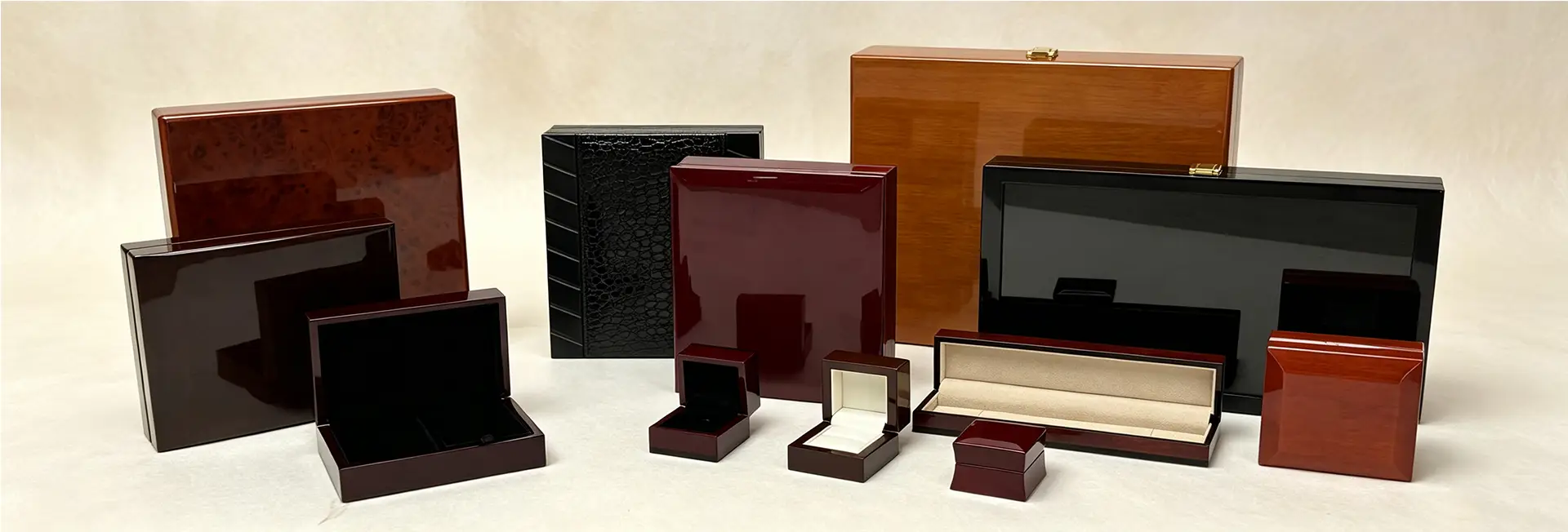
Jewelry box constructions we manufacture
Most buyers arrive with a shape in mind and a budget already fixed. These six constructions cover the range from a printed paper box at the entry price to a lacquered hardwood case for fine jewelry, and each one can be lined, inserted and finished to the same brand standard.
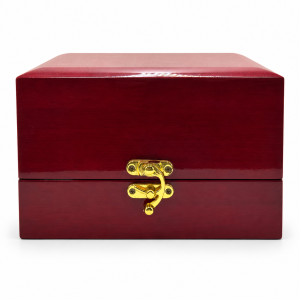
Rigid set-up boxes
The default for retail. 2.0–2.5 mm greyboard wrapped in paper, PU or velvet, with a lid that holds its shape after a thousand openings.
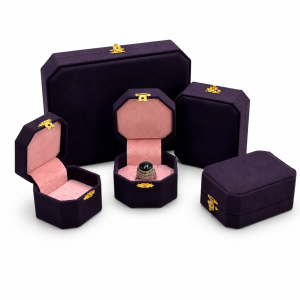
Velvet & flocking lined boxes
Flocked paper for high volume, real velvet over foam for premium lines. Both hold a ring or pendant without scratching the plating.
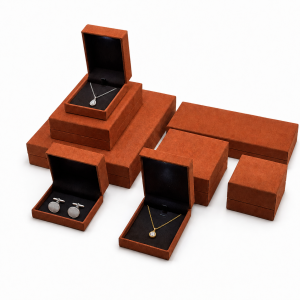
Drawer & sliding boxes
A sleeve plus an inner tray with a ribbon or finger pull. More theatre at unboxing than a lift-off lid, at a modest cost step.
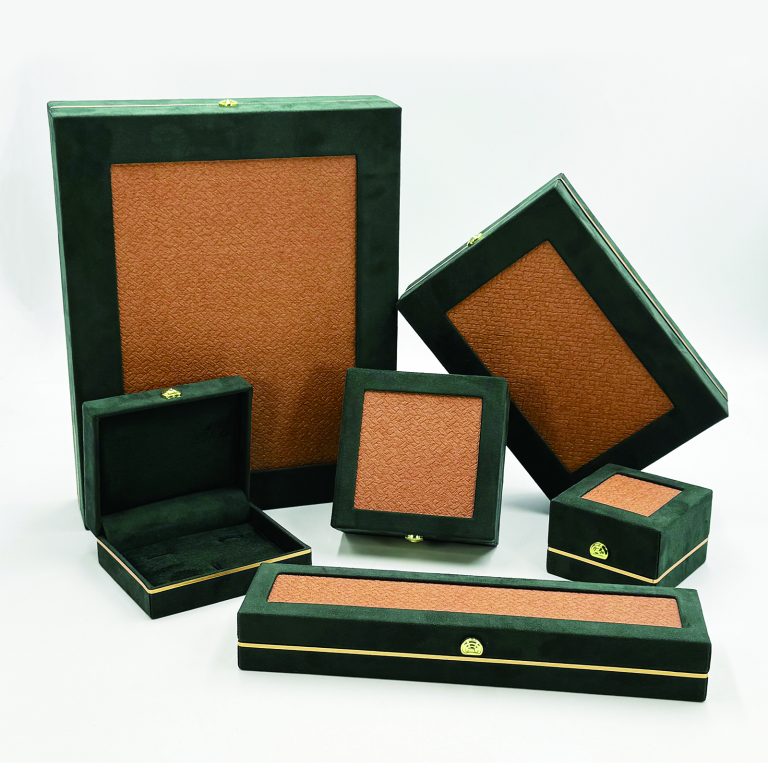
PU leather travel cases
Zip-around or snap-case formats with compartmented trays. The format buyers choose for travel retail and gift-with-purchase.
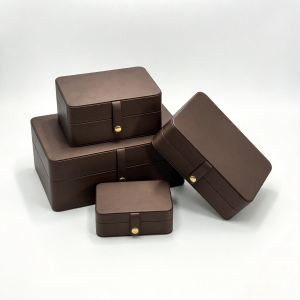
Wooden & lacquer cases
MDF or hardwood, high-gloss lacquer, piano hinge and metal clasp. The tier where the box itself becomes part of the product.
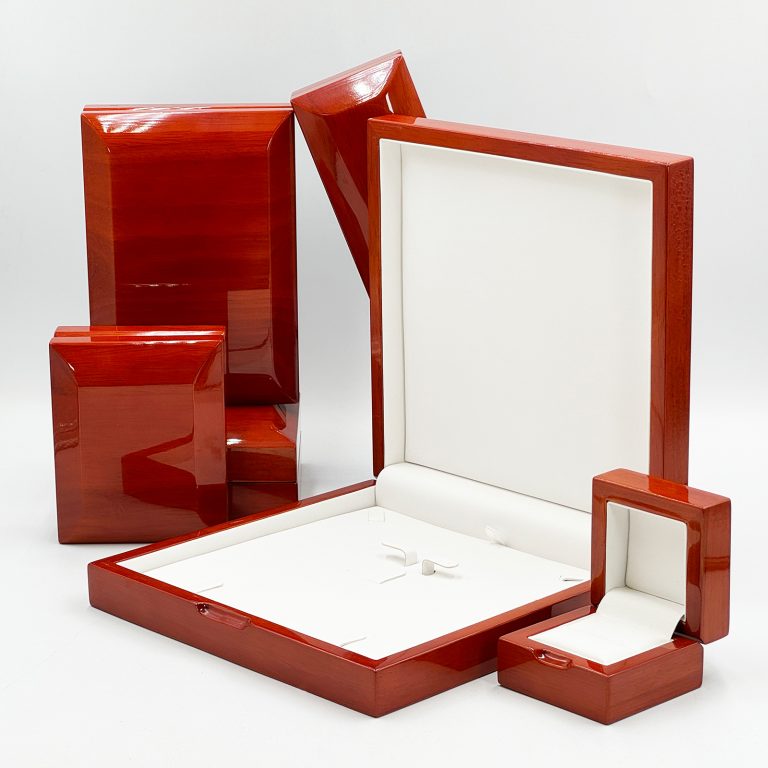
Display trays & transparent lids
Counter trays, stackable inserts and clear-lid boxes for stock rooms and showcases — the other half of most jewelry packaging orders.
Materials and construction, specified line by line
A jewelry box is six decisions stacked on top of each other. Change one and the price and the feel both move. This is the spec sheet our quotation is built from, so you can see exactly what you are comparing when two suppliers quote different numbers.
| Layer | What we normally use | Why it matters to the buyer |
|---|---|---|
| Board | 2.0 mm / 2.5 mm / 3.0 mm greyboard; MDF for lacquer and wood-look cases | Board thickness is the single biggest driver of how “premium” the box feels in the hand. Downgrading 2.5 mm to 2.0 mm is the most common quiet cost cut. |
| Outer wrap | 128–157 gsm art paper, textured specialty paper, PU leather, velvet, matte or gloss lamination | Wrap decides scratch resistance and how the logo prints. Textured paper hides handling marks better than gloss film in retail. |
| Lining | Flocked paper (economy), short-pile velvet, suede-textured fabric, satin, leatherette | Lining touches the product. On plated or polished pieces, a coarse flock can leave micro-scratches that show up as returns. |
| Insert | Die-cut EVA, PU foam, moulded pulp, cardboard platform wrapped in velvet | The insert is what actually holds the piece still in transit. It has to be cut to your item, not to a generic slot. |
| Closure | Magnetic flap (two hidden magnets), ribbon tie, elastic band, metal clasp, zip | Magnets are cheap and quiet; clasps read as heirloom. Ribbon pulls add a step in assembly and show up in the price. |
| Hardware | Gold, silver, rose-gold or blackened steel hinges, corners, locks and nameplates | Hardware tone has to match the logo foil or the box looks assembled from two different products. |
Surface finishes and branding options
Branding is applied after the box is wrapped, so the finish and the logo method have to be chosen together. These are the combinations that survive handling and shipping without going dull or peeling at the edges.
- Hot foil stamping — gold, silver, rose gold, copper, matte black. Sharpest result on smooth paper and PU; the standard for logos under 40 mm.
- Debossing and embossing — a pressed logo with no colour. Reads as restrained and premium; pairs well with textured paper.
- UV spot printing — gloss varnish over a matte wrap. Good for patterns and fine line work that foil cannot hold.
- Screen printing — one or two flat colours on velvet, PU or board. Best value for large solid areas.
- Digital and offset printing — full-colour artwork wrapped around the whole box, including photography.
- Lamination — matte, gloss or soft-touch film. Soft-touch is the finish buyers most often ask for by feel rather than by name.
- Metal nameplates and badges — engraved or etched plates riveted to wooden and lacquer cases.
- Edge painting and ribbon pulls — colour-matched to the lining, the detail that separates a gift box from a shipping box.
Factory or trading company — how to tell before you pay a deposit
Most “jewelry box suppliers” you will find on the first pages of Google are trading offices with a catalogue. That is not automatically a problem, but it changes who controls the sample, the lead time and the fix when something goes wrong.
| Question to ask | Manufacturer (YUNFAI) | Trading company, typically |
|---|---|---|
| Who cuts the board? | Our own workshop in Foshan; die-cutting, wrapping and assembly under one roof | Subcontracted to a factory you never speak to |
| Can I change the insert? | Yes — new die for the EVA or foam insert, quoted separately, usually 3–5 days | Often “the factory’s mould, take it or leave it” |
| Who approves the sample? | You approve a physical pre-production sample; that sample is the reference for the bulk run | A photo of a “similar” box |
| What happens on a defect? | Remake or credit against the approved sample, decided inside the same conversation | Escalated to a third party, timeline resets |
| Lead time | 20–30 days after sample approval for standard constructions | Quoted, then extended once the order is placed |
| Small runs | From 300 pcs per design in most constructions | Aggregated with other buyers’ orders, so your changes wait |
What actually changes the price
Five variables move a jewelry box quotation. Nothing else does, no matter how the quote is presented. If two suppliers are far apart on price, one of these five is different.
From drawing to carton: how an order runs
The sequence below is what happens after you send artwork or a reference. Nothing is charged for the quote or the dieline; tooling and sampling are quoted separately and credited against the bulk order in most cases.
Quality control before the carton is closed
Jewelry packaging fails in ways that only show up after a season on a shelf: corners that split, foil that dulls, lining that sheds, magnets that let go. These are the checks we run because they are the checks buyers come back with.
- Corner and edge integrity — every corner of a wrapped rigid box is pressed and inspected; split corners are the first defect a customer notices.
- Foil adhesion — tape pull on stamped areas, at the start and end of each production run, not just the first box.
- Lining colour consistency — velvet and flock are checked against the approved sample under daylight, because dye lots shift.
- Magnet and closure strength — open-and-close cycles on the assembled box to confirm the lid still seats.
- Drop and compression — packed cartons dropped and stacked to simulate the leg of the journey your box actually takes.
- Insert fit — the intended product, or a same-size dummy, is placed in the insert and checked for movement.
- Print and colour match — against your Pantone reference or the approved proof, on the actual substrate.
- AQL sampling — cosmetic and functional defects judged separately, with photos of any rejection sent before shipping.
Artwork, dielines and what to send us
The fastest way to a correct quote is to send four things in one message. Buyers who send all four usually have a price the same day.
| Send this | Format and notes |
|---|---|
| Box size | Internal dimensions in mm (L × W × H). If you only know the product size, send that and we will add the clearance. |
| Artwork | AI, PDF or high-resolution PNG with fonts outlined. If you have no artwork yet, tell us the logo treatment and we will build the dieline first. |
| Quantity | Target quantity plus a second number you could live with — the price step between them is often the deciding factor. |
| Reference | A photo of a box you like, or a competitor’s packaging. A picture removes more ambiguity than a page of adjectives. |
Export, cartons and shipping
Jewelry boxes are light but bulky, so freight is usually quoted on volume rather than weight. Knowing the carton plan before you order stops the shipping invoice from being a surprise.
- Cartons — export-grade corrugated, inner dividers so boxes do not rub, poly bag per unit on request.
- Volume — we send the CBM per carton and per order with the quotation so you can price freight before committing.
- Ports — shipment from Shenzhen, Guangzhou or Foshan by sea, air or express, per your forwarder’s preference.
- Incoterms — EXW, FOB, CIF and DDP quoted on request; DDP is common for first orders into the EU and US.
- Documents — commercial invoice, packing list and certificate of origin prepared with the shipment.
- Barcodes and labels — retail barcodes, price tickets and Amazon FNSKU labels applied in-house if you supply the files.
- Consolidation — mixed orders of boxes, trays and pouches shipped together to cut the per-unit freight.
- Repeat orders — the dieline and specification are kept on file, so a reorder skips straight to sampling or production.
Frequently asked questions
Related product lines
Tell us the size, the quantity and the look you are after. We will come back with a dieline, a material spec and a price per piece — and tell you honestly if a cheaper construction does the same job.