

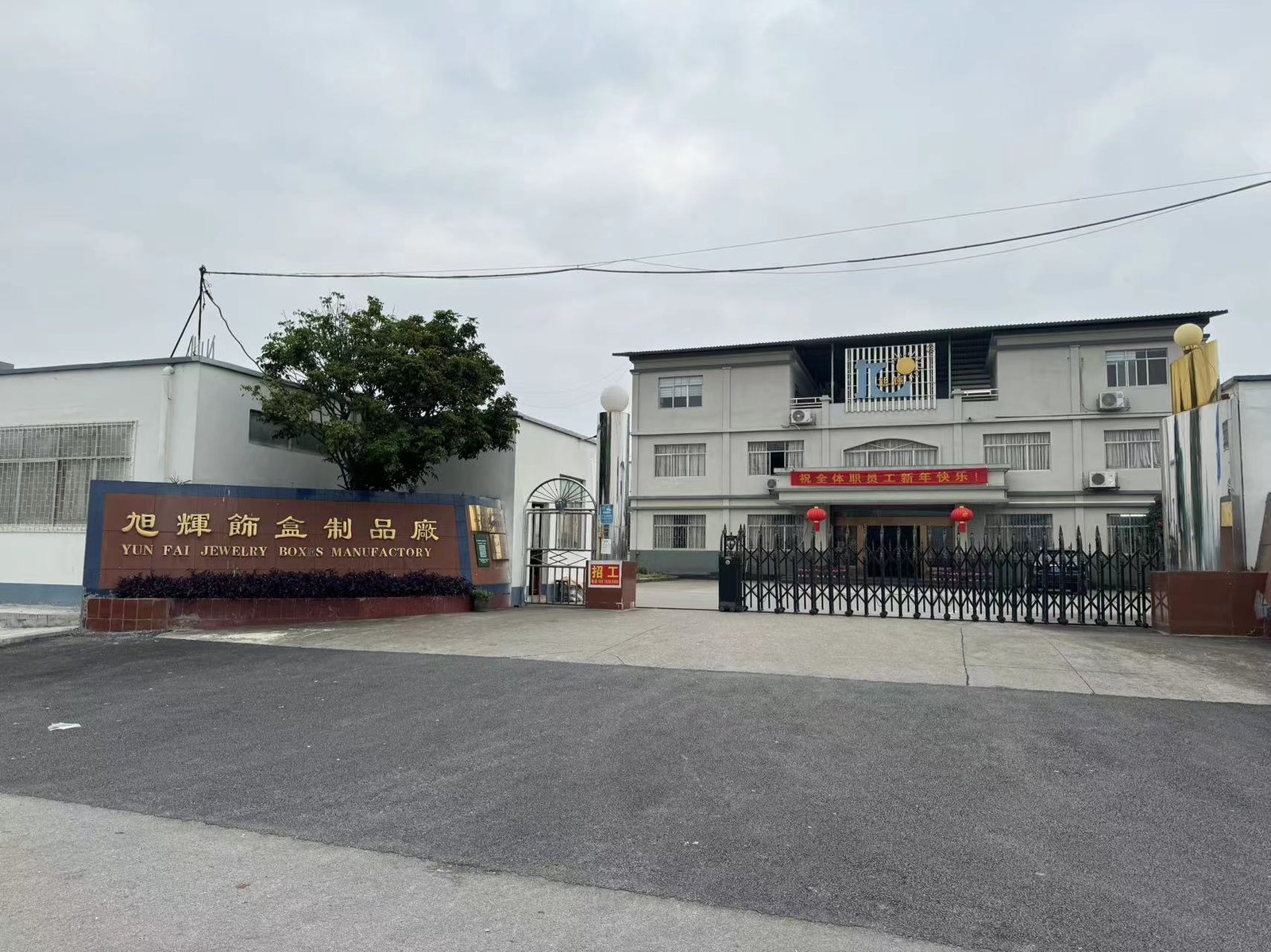
Every autumn, a cluster of enquiries lands in our inbox with the same shape. A brand has a launch date in spring, artwork that is almost finished, and an assumption that a box factory can absorb the order in six weeks.
Sometimes we can. More often the calendar says otherwise, and the constraint is almost never the cutting, the gluing or the wrapping. It is the queue standing in front of each of those steps, and the fact that nobody quotes the queue.
What follows is the calendar we use internally when a buyer asks whether a date is realistic. It is written out here so you can check it against your own launch plan, and so the conversation starts from the same set of numbers.
Why the Lead Time in a Quotation Is Not Your Lead Time
Open any quotation from a Chinese packaging factory and you will find a line that reads something like “production lead time: 30 days.” That number is real. It is also a fragment.
It usually covers bulk production only, and it usually starts counting from two events that have not happened yet when you first read the document: sample approval, and receipt of deposit. Sampling, tooling, material procurement, inspection, booking and ocean transit all sit outside the 30 days. A buyer who plans around that single figure is planning around roughly a third of the project.
The delivery term matters just as much. Ex-works means your clock starts at our loading dock. FOB moves the handover to the port. DDP pushes the entire chain, including customs, onto the supplier’s side. The same factory, the same production line, and three very different calendars depending on which three letters sit in the quotation. If the commercial terms are still open when you are building a timeline, it is worth reading how a custom jewelry box quote is actually assembled before you compare totals, because lead time and cost move together more than most buyers expect.
One habit separates buyers who hit their launch dates from buyers who do not: they ask for the calendar stage by stage, in writing, and they ask what each stage’s clock starts on.
Stage One: Brief to Quotation (Days 1 to 7)
A quotation is only as fast as the brief is clear, and this stage is where a two-week delay is usually born. Six details decide whether the answer arrives in three days or three weeks:
- Outer dimensions, or the internal dimensions the product actually needs. Half our enquiries give one and assume the other.
- Quantity per SKU and per colour, not just a total. Ten thousand pieces across six colours is a different project from ten thousand in one.
- Construction: greyboard thickness, lid style, hinge type, magnet count, lining method.
- Logo method, because hot foil, screen print, UV and debossing use different tooling and different tolerances.
- How the box ships: individual poly bag, tissue, sleeve, master carton count.
- Destination market, since labeling and documentation requirements differ by country.
Quotes that come back 40% apart are rarely a pricing trick. They are usually three different boxes. One factory priced a 1.5mm greyboard shell with two magnets; another priced 2.0mm with four, a ribbon pull and a moulded insert. Before you treat a spread like that as negotiation room, get both bills of materials on one page.
Stage Two: Sampling (Days 7 to 30)
What the first sample is really testing
A sample is not a preview of the finished product. It is a test of five things that are hard to see on a spec sheet: whether the insert actually holds the piece without pressure, whether the colour reads the way it did on screen, whether the hinge feels right at the angle a customer will open it, whether the magnets are strong enough to survive a retail shelf without gaping, and whether the logo lands inside its registration window.
Most of these fail on the first pass. That is normal, and it is why the second sample exists. What is not normal is discovering on round three that the insert cavity was designed from a photograph of the product rather than from its dimensions. If a piece is going into a fitted cavity, send the piece, or send a dimensioned drawing with the tolerance marked. This is the same discipline that keeps a box structure from failing in transit, applied one step earlier.
The queue behind every revision
A revision does not restart the sample at day one, but it does rejoin the queue. The sample room schedules in batches, so a change approved on Monday might be built on Thursday. Add a material re-pull, and a logo plate change, and a single round can absorb eight to ten working days without anyone being slow.
Two rounds are typical for a stock-mould design. Three is common when the insert is new. Each round costs roughly a week to ten days, and that is the single most predictable place to lose a month.
The 48-hour colour check worth doing
Approve colour twice before you sign off: once in daylight near a window, once under the warm 3000K lighting most jewellery counters use. A burgundy that looks restrained in a photo studio can turn brown under retail light, and a dusty rose can go grey. Phone photos of a sample are not evidence, because every camera applies its own colour profile. Ask for a physical swatch of the actual production material and keep it. When the bulk order arrives eight weeks later, that swatch is the only neutral arbiter you will have.
Stage Three: Tooling and Material (Days 20 to 45, Running in Parallel)
The moulds we already own, and the ones we have to cut
This is where an established factory buys you time. Our plant holds more than 1,000 in-house moulds built up since 1998, covering the common rectangular, octagonal, round and book-style formats. If your design sits inside one of them, you skip seven to twelve working days of die cutting, foil plate making and screen frame preparation, and you skip the first-article check that follows.
If it does not, the tooling is not difficult, just sequential: a cutting die, a hot foil plate or screen frame, a sample to prove the fit, then a first-article approval before bulk. Buyers who browse the existing jewelry box formats before sketching usually find a shape within 5mm of what they wanted, and 5mm is often the difference between a 70-day project and a 95-day one.
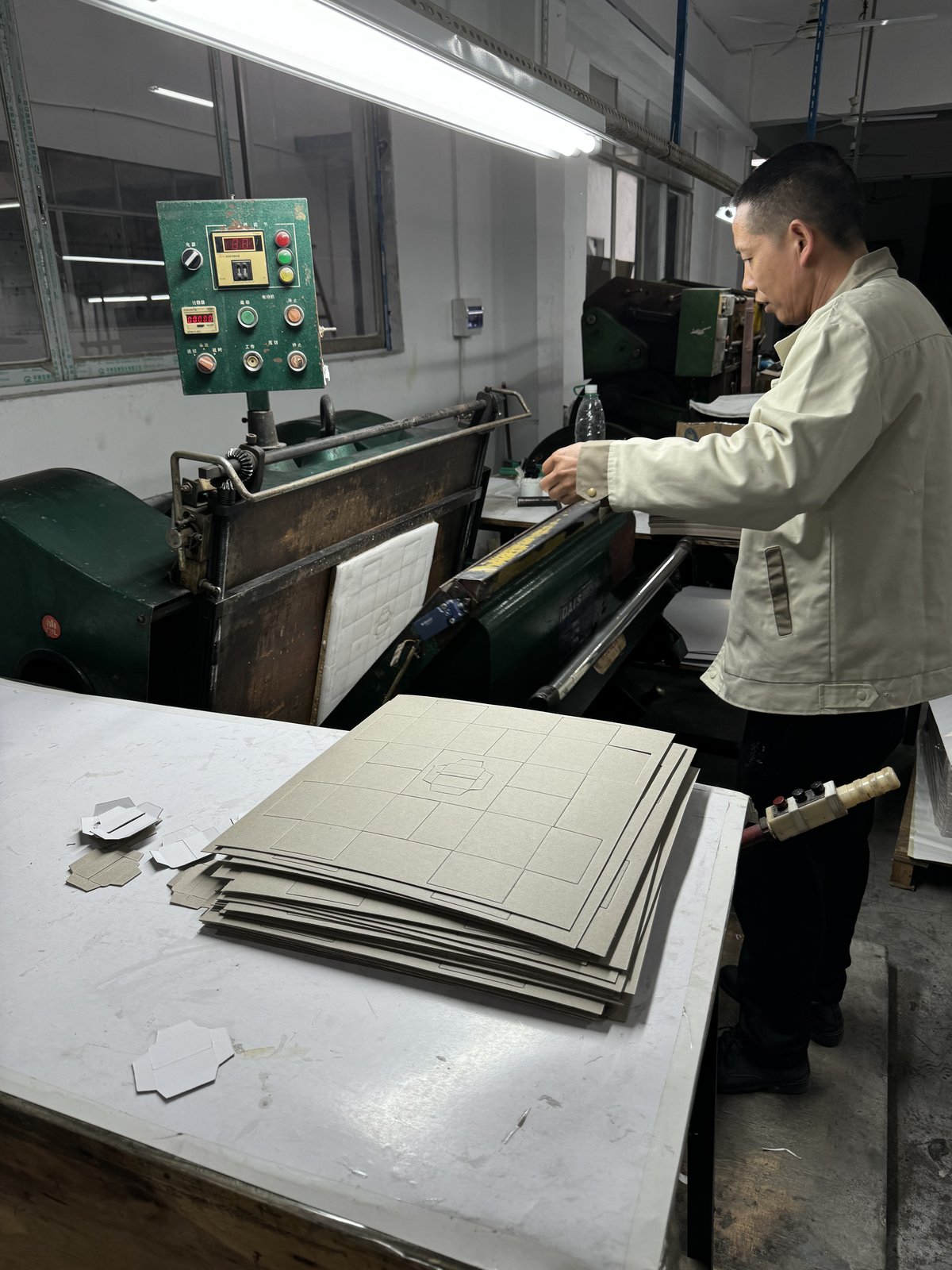
Die cutting greyboard panels to a new shape. A stock mould skips this queue entirely.
Material is where specialty orders slip
Standard PU leatherette, black velvet flocking, 1200gsm greyboard and art paper are stock items. We hold them. The delays come from the materials that are specified for a reason and cannot be substituted:
Dyed-to-match velvet and the MOQ trap
A velvet dyed to a specific Pantone is a mill order. It typically runs 15 to 25 days, carries its own minimum, and will not match a previous dye lot exactly. Brands that order 3,000 boxes now and 3,000 later often find the two batches sit a shade apart under the same light. If the colour is the point, place the full quantity in one run and store the surplus, or accept a stated tolerance on the second lot.
The same logic applies to embossed papers, metallic leatherette and custom-coloured suede. None of them are slow on their own. They are slow because they are ordered after the sample is approved rather than alongside it.
Stage Four: Bulk Production (Days 45 to 70)
Bulk is the most predictable stage and the one buyers worry about most. On our floor, 200+ staff run parallel lines, and a 10,000-piece order of a mid-complexity box typically clears in 20 to 30 working days once material is released to the line.
What stretches that number is not volume. It is changeover. Every colour change means new material at every station, re-set foil temperature, and a first-off check. Six colours across one line can add a week compared with the same total in two colours. Ten thousand pieces in one colour is a smoother run than six thousand in six.
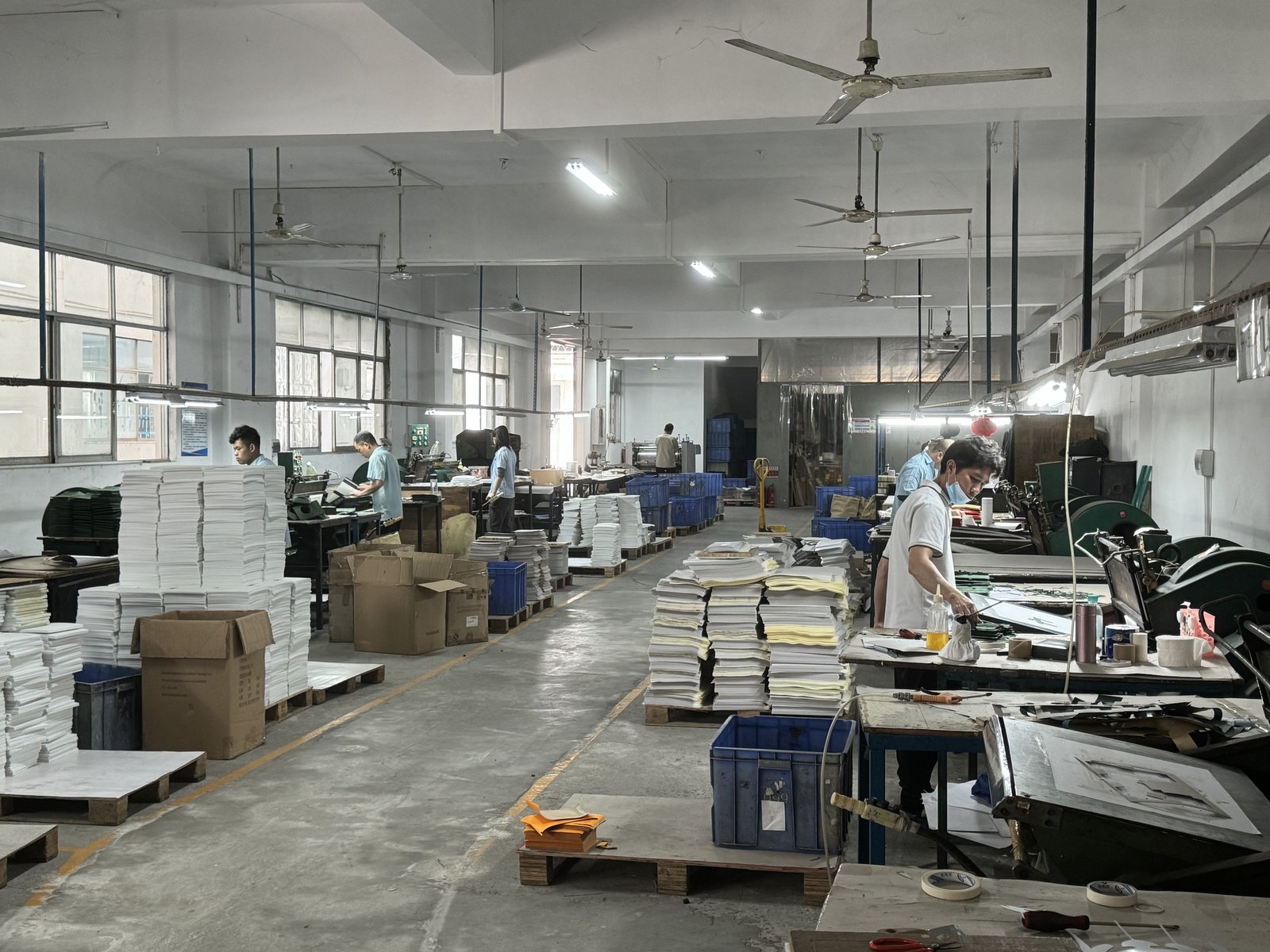
Work in progress waiting between stations. The stacks are a useful indicator: when they grow, the constraint has moved upstream, not to the assembly line.
There is also a seasonal variable that almost no quotation mentions. Greyboard and wrapped paper absorb moisture, and in the humid months along the Pearl River Delta, board has to be conditioned in a dry room before it is wrapped or the paper will wrinkle at the corners three days later. That conditioning adds two to four days in summer and none in winter, which is one reason a July order can run longer than an identical October order. Scale helps here, and it is part of how we run high-gloss wooden lines for global supply chains without the finish drifting between batches.
Stage Five: Inspection, Packing and Documents (Days 70 to 78)
Before anything is packed, the bulk is checked against the approved golden sample, not against the drawing. Odour, edge wrap, magnet seating, hinge alignment and logo registration are the five that cause most rejections, and each of them is easier to catch here than at your warehouse.
Packing and paperwork take five to eight working days and are usually underestimated. Individual poly bags, tissue, silica, a carton label with your SKU code, and a packing list that matches your customs broker’s expectations all have to be agreed before the line finishes, not after. Ask early whether the factory can print and apply your labels, because doing it yourself after arrival costs more than the labels ever will.
The Chinese New Year Cliff
No other single event reshapes a packaging calendar like the Spring Festival, and no quotation will warn you about it.
What late January actually looks like on the floor
The holiday is officially about a week. The effect is not. Production workers travel home across the country, many of them leaving one to two weeks before the official start to secure a train ticket, and returning one to three weeks after, depending on the year and the province. Line capacity in the last ten days before the holiday is a fraction of normal, and the first two weeks after are spent rebuilding teams rather than running at full rate.
For the 2027 festival, which falls in the first week of February, the practical cut-off for shipping before the break is mid-December 2026. Anything confirmed after that is realistically a March delivery, whatever the quotation says.
Where Q4 orders are actually won
Work backwards from a Black Friday shelf date and the shape becomes obvious. Retail floor by late October; container departing by late August; production complete by early August; material released by mid-July; sample approved by June; brief started in April.
That is a ten-month project wearing a five-month label. Brands that treat packaging as a Q3 task are competing for the same capacity as everyone else who made the same assumption, and capacity in August is the scarcest thing in the industry.
The Transit Maths Nobody Puts in the Quotation
Port-to-port sailing time is the number buyers remember, and it is about half the journey. A realistic door-to-door estimate adds:
- Booking and space confirmation: 5 to 10 days, longer in the August to October peak.
- Trucking from factory to port and container loading: 2 to 4 days.
- Ocean transit: roughly 14 to 18 days to the US West Coast, 30 to 36 to the US East Coast, 30 to 38 to North Europe, 16 to 22 to Australia.
- Customs clearance and port release: 3 to 7 days.
- Drayage to your warehouse and unloading: 2 to 5 days.
When air freight is the cheaper decision
Air is typically four to eight times the cost of ocean per kilo, which sounds prohibitive until it is compared with the cost of a missed date. If a launch slips a month, the lost full-price selling window usually dwarfs the freight difference on the first few hundred units.
The pattern that works: ship 10 to 15% by air to cover launch and initial replenishment, and send the balance by sea. Some brands also air the display units and sea-freight the packaging, since display carries the higher margin and the boxes are the heavier cargo. Deciding this in June costs nothing. Deciding it in September costs whatever the airline wants.
Four Order Types and What They Really Take
Door-to-door, from brief to your warehouse, with a normal production queue and no air freight. Add two to three weeks if the order is confirmed between November and February.
| Order profile | First order | Repeat order | What sets the timeline |
|---|---|---|---|
| Stock mould, printed logo, one SKU, 3,000 pcs | 75–90 days | 50–60 days | Sample rounds and colour approval |
| New mould, custom insert, three SKUs, 10,000 pcs | 95–115 days | 65–80 days | Tooling plus material procurement |
| Program order, six colours, 30,000 pcs | 110–130 days | 75–95 days | Colour batching and line allocation |
| Lacquered wooden box with metal hardware | 100–125 days | 70–85 days | Lacquer coating and curing cycles |
How to Compress a Calendar Without Buying Risk
Six levers, in order of how much they actually return:
- Freeze the design before you shop. Comparing quotes on three different specs guarantees you will re-quote later, and re-quoting costs more time than it saves.
- Choose a stock mould for the first order. Keep the custom silhouette for the second run, when volume justifies the tooling.
- Approve one sample, not four. Consolidate feedback into a single round. Circular comments from three stakeholders add a week per loop.
- Order material with the sample, not after it. This single change removes one to three weeks from most specialty projects.
- Pre-book space before production ends. A finished order without a booking is not a shipped order.
- Split the shipment. Air the launch quantity, sea the rest. It buys a month for the cost of a fraction of the cargo.
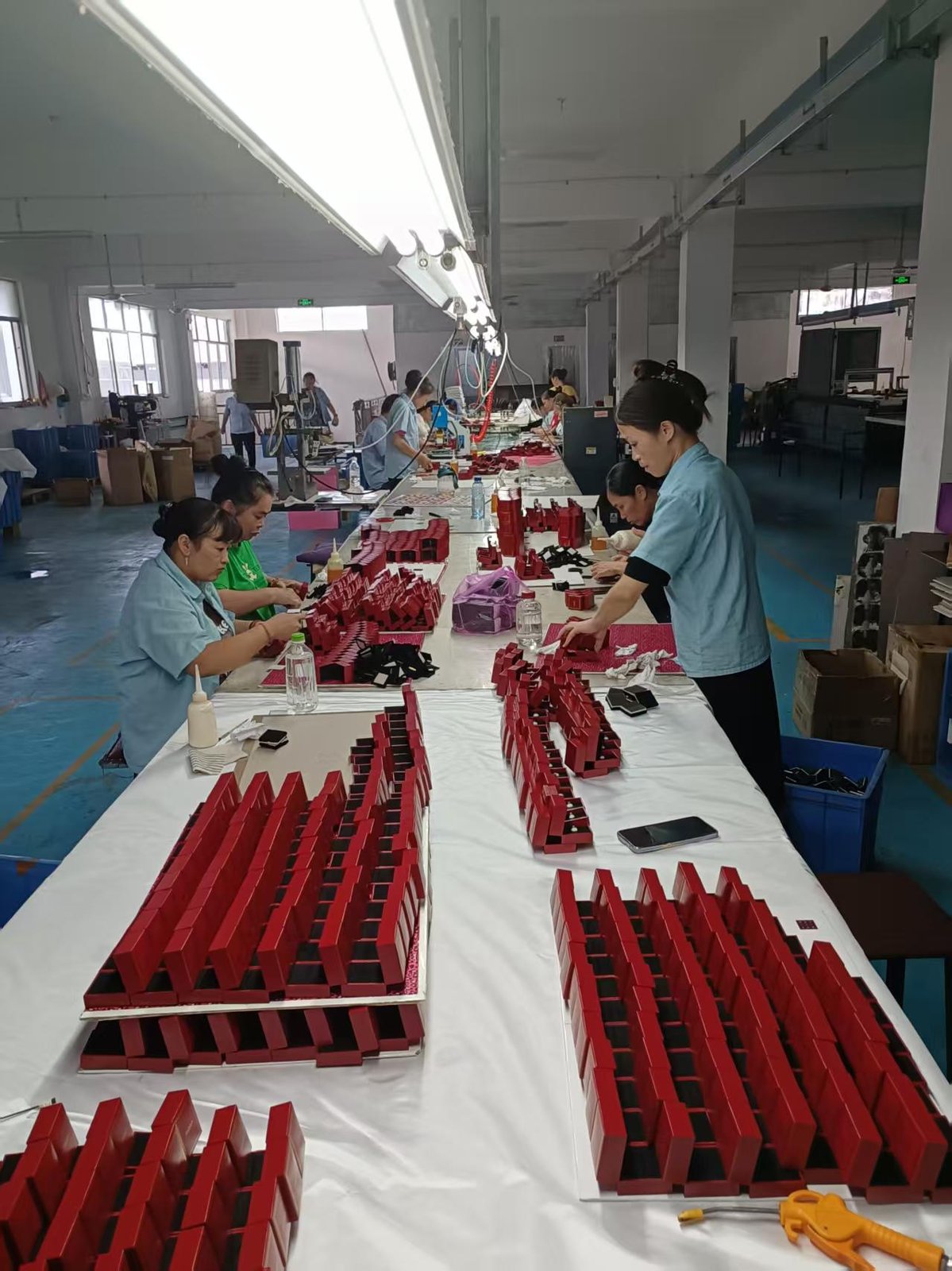
Hand assembly at the end of the line. This stage is fast; the queue that feeds it is not.
Questions That Arrive in the First Email
How long does a fully custom jewelry box take from China?
Nine to twelve weeks door to door for a first order with new tooling, six to eight for a repeat. The variable that moves most is not the factory but the sampling loop, which is largely under the buyer’s control.
What is a realistic MOQ?
For stock moulds with a printed logo, 500 to 1,000 pieces per colour is workable. For a new mould with a custom insert, 1,000 to 3,000. Below that, the tooling cost per unit stops making sense and a stock format with a custom label usually serves the launch better.
Can we get samples before the holiday shutdown?
Yes, if the brief arrives by early November. After mid-November, sample room capacity competes with pre-holiday production and a sample may not be physically possible until March. This is the most common disappointment of the year, and it is entirely predictable.
Does a repeat order really take less time?
Two to four weeks less, because tooling, insert fit and colour are already proven. We keep the golden sample and the material swatch on file for exactly this reason. The saving disappears if the material is discontinued or the logo artwork changes, so it is worth confirming both before you promise your own team a shorter cycle.
If You Only Take One Thing From This
The factory controls production. Nobody controls the calendar alone. Roughly half of the delay in a typical packaging project happens before a single box is cut, in the gap between a rough idea and an approved sample with released material.
Send us a launch date before you send a design, and we will tell you honestly whether it holds. That is a shorter conversation than the one that happens four months later. You can see how the plant is actually set up before you decide anything, and if the brief is still open, it may be worth reading where packaging demand is heading next year so your first mould is still the right one in eighteen months.