

Two quotations land on the same desk in the same week. Same drawing, same dimensions, same Pantone number, same quantity. One supplier says $0.95. The other says $1.85.
Both are telling the truth. That is the part that unsettles buyers.
The gap is rarely greed on one side or charity on the other. It is almost always a difference in specification that the drawing never captured — board density, how many finishing passes the surface needs, whether the insert is die-cut or hand-wrapped, whether tooling is amortized into the unit price or billed separately. Once you know where those differences hide, two quotes stop being a coin flip and become a comparison.
This is the breakdown we walk through with buyers who ask why our price is higher, and with buyers who ask why someone else’s is suspiciously low.
The unit price is not the price of the box
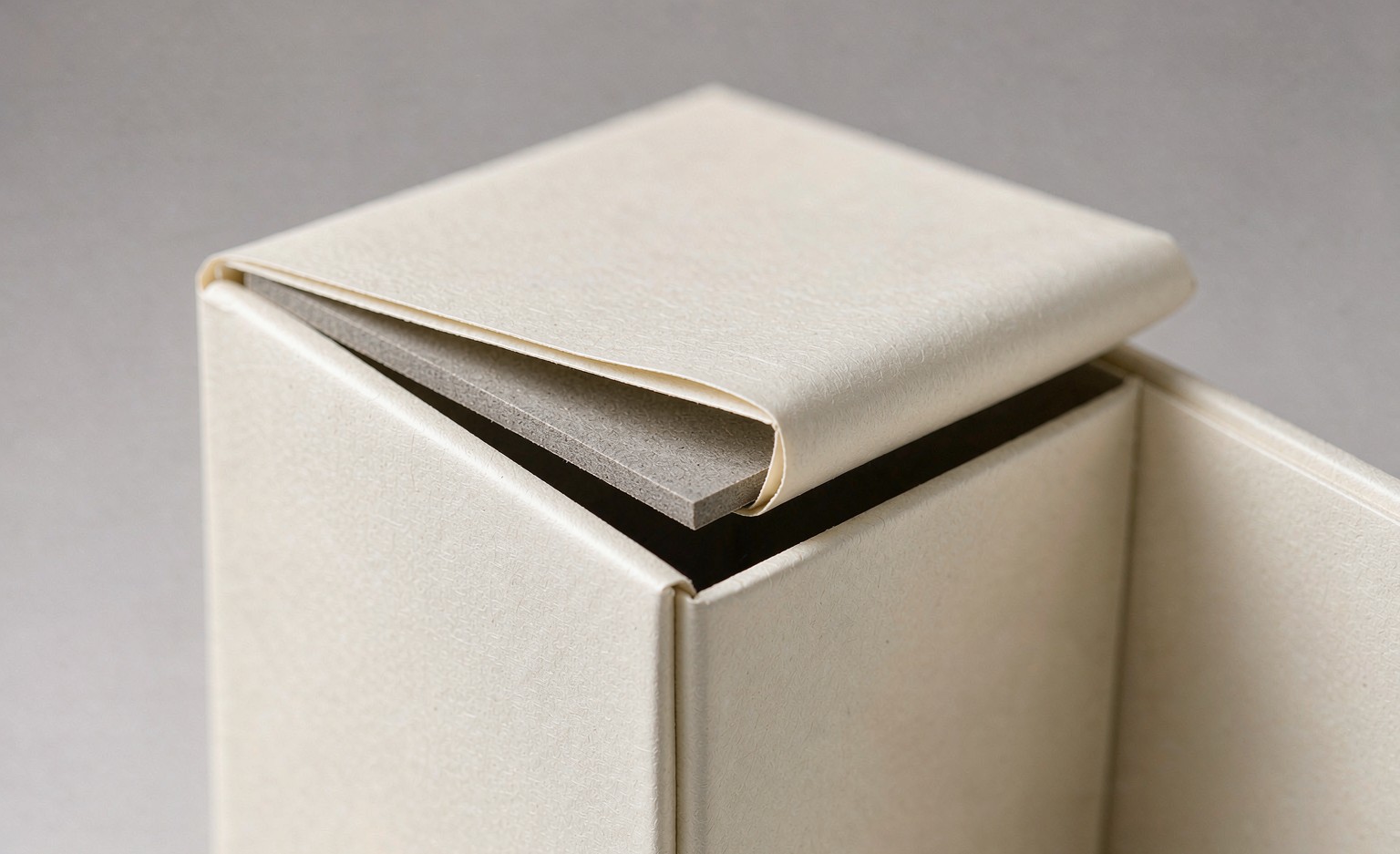
A jewelry box sitting on a counter costs, in materials, a fraction of what you pay. The rest is the cost of making three thousand of them identical, packed, inspected, and delivered on a date you can plan around.
That sounds like a sales line. It is a mechanical fact of how rigid boxes are made. Unlike a printed carton, a rigid box is assembled from separate pieces: a greyboard core, a wrap material cut and folded around it, a lining, an insert, hardware. Every one of those pieces is cut, glued, and often handled by hand. Labor doesn’t scale down with order size the way material does.
So the honest way to read a unit price is to split it into five layers, then look at each one separately.
Layer one: the board and the wrap
Material is the largest single block in most quotations — typically 30% to 40% of unit cost at volumes above 3,000 pieces. It is also where the widest quality range exists under identical-sounding descriptions.
Greyboard: why 1.5 mm is not always 1.5 mm
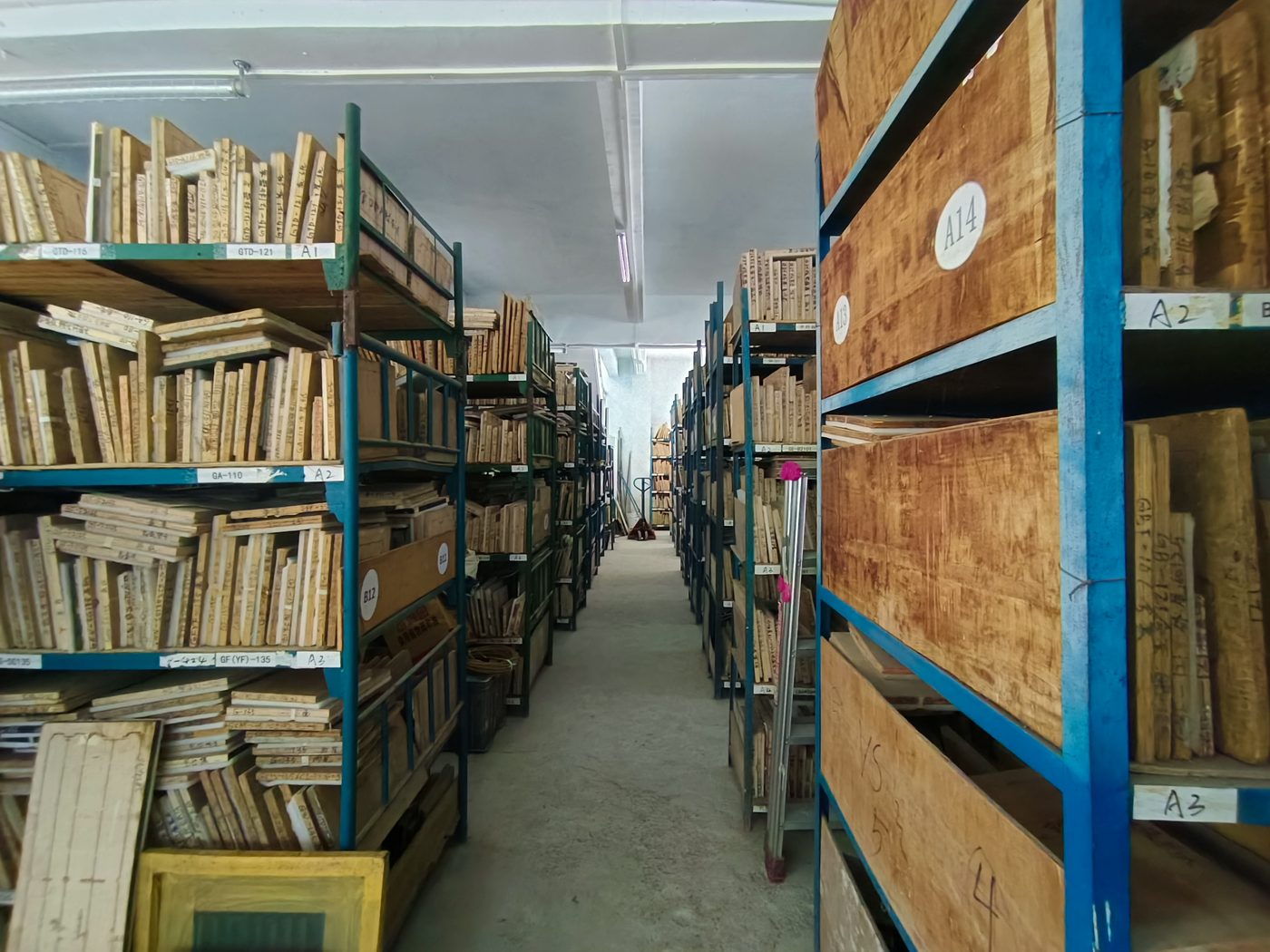
Every rigid jewelry box starts with greyboard, also called grey chipboard. Buyers specify thickness because thickness is visible on a spec sheet. Density is what actually determines how the box behaves.
Density, not thickness
A 1.5 mm board at 800 g/m² and a 1.5 mm board at 1,200 g/m² measure the same with calipers and feel completely different in the hand. The denser board resists edge crush, holds a crisp corner after the wrap is pulled around it, and doesn’t develop the soft, slightly spongy feel that reads as cheap. It also costs more — often 25% to 40% more for the same nominal thickness.
Moisture content and warping
There is a second variable most buyers never see: moisture content. Board that leaves the supplier above roughly 8–10% moisture will lose that moisture in a dry warehouse or a heated container, and the lid will bow. We store board in a controlled area and check moisture before cutting, because a warped lid cannot be fixed after assembly — it can only be scrapped. If you have ever received a shipment where the lids sat slightly proud at the corners, this is usually the reason, and it has nothing to do with the box design.
The wrap decides the ceiling of the whole product
The surface material is where most of the perceived value is created, and where the biggest cost swing sits. Roughly in ascending order of cost:
- Coated art paper — the workhorse. Prints beautifully, wraps cleanly, and is the cheapest way to get a full-colour surface. It is also the most honest material about its own limits: paper edges show wear at the corners faster than fabric or leather.
- Specialty textured paper — embossed, felt, or touch-laminated paper. Adds 15–30% over standard art paper and is one of the most cost-efficient upgrades available, because it changes how the box feels without changing anything structural.
- Flocking (velvet-look fabric) — a fibre surface applied over board or paper. Warm, tactile, and popular for bridal and gift programs. Its cost is driven by fibre density, not by the look of the swatch.
- Microfiber and suede-effect materials — finer fibre, denser hand, considerably more expensive. Increasingly specified by brands that want the velvet look without the shedding reputation flocking has earned in some markets. We compared the three material families in detail in velvet vs microfiber vs PU leather.
- PU leatherette — the standard for mid-to-premium jewelry packaging. Price depends on backing cloth, coating weight, and whether the grain is embossed or release-paper cast. Two swatches that look identical on a screen can differ by 60% in cost.
- Wood, veneer, and piano lacquer — the top of the range. Cost is driven by the number of lacquer coats and the sanding between them, which is why two high-gloss wooden boxes can sit at very different prices. Our breakdown of why some high-gloss wooden boxes feel luxurious and others look like plastic covers where that money goes.
The trap to watch for: “same look, half the material cost” is usually achieved by thinning the wrap. Thinner leatherette shows the board texture underneath after a few months, and thinner paper tears at the fold on the second opening. Neither problem appears on a sample you handle once.
Layer two: surface decoration is billed per pass
Every decorative process is a separate trip through the factory. Print one pass. Foil stamp one pass. Emboss one pass. Each pass means setup, registration, drying time, handling, and its own rejection rate.
Decoration typically runs 10% to 20% of unit cost, and it is the layer where specifications inflate fastest. A brief that starts as “logo on the lid” can quietly become foil logo plus debossed border plus spot UV on the interior plus edge gilding — four passes instead of one, and roughly double the decoration cost.
The rule worth remembering: cost scales with the number of passes, not with how big the design is. A large, simple foil logo costs less than three small decorations in three different places.
We go through the trade-offs between foil, screen printing, UV, and deboss in a separate article — the short version is that the cheapest method is often the wrong one, and the most expensive is rarely necessary.
Layer three: the insert is where labor hides
Nobody photographs the insert, and it is frequently the most expensive component after the wrap.
Three insert constructions, three cost profiles
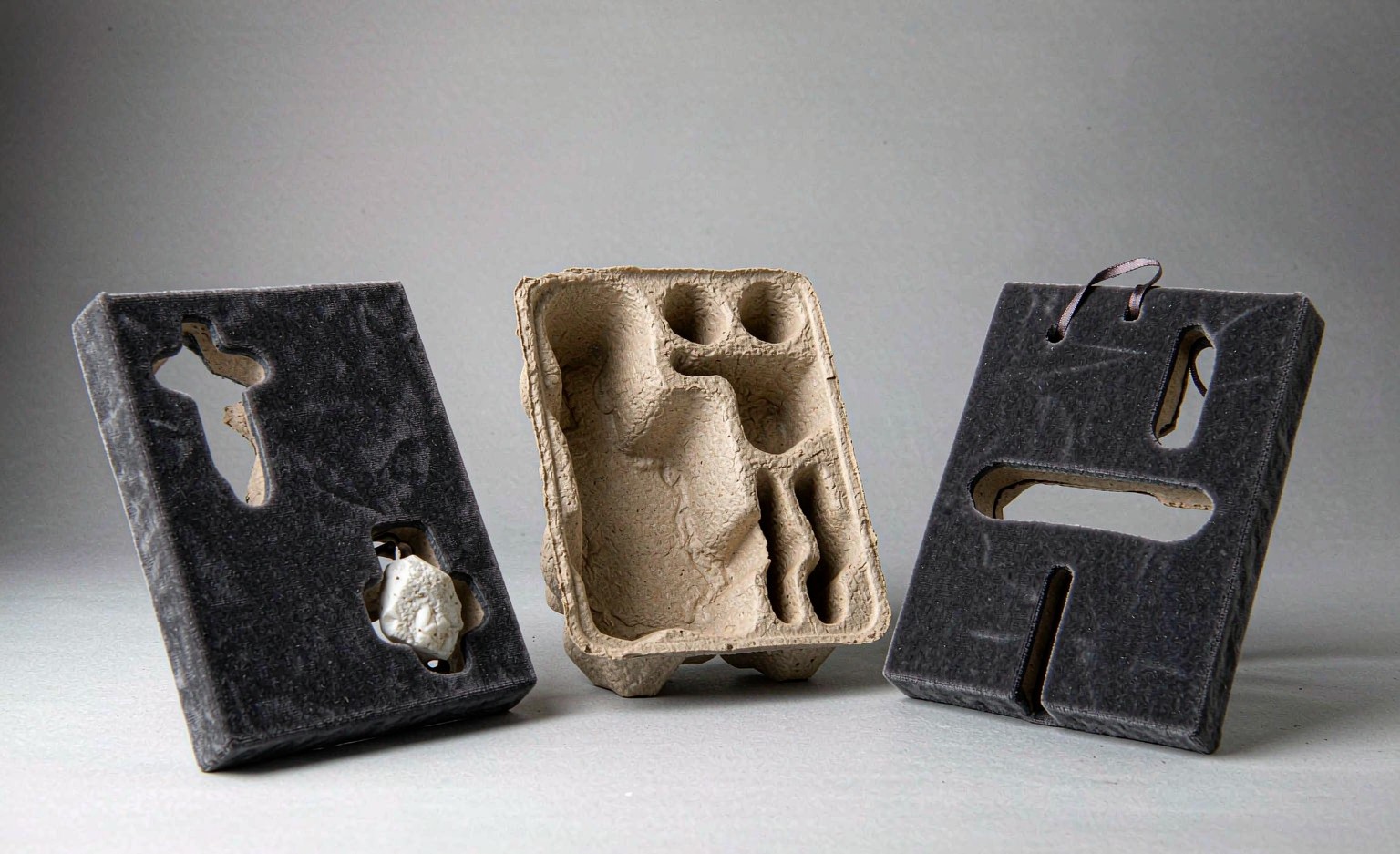
Die-cut EVA foam, velvet-wrapped. The default for premium jewelry. A foam block is cut to the exact cavity shape, then wrapped in fabric or flocked. The cutting is fast; the wrapping is not. Each cavity edge has to be tucked and glued by hand, and a set box with six cavities may take several minutes of wrapping per piece.
Molded pulp or thermoformed PET. Cheaper per unit at volume because the shape comes out of a mold in one shot, but the tooling is expensive and the finish reads as industrial unless it is flocked afterwards.
Velvet-wrapped board with hand-cut slots. The most labor-intensive option and common in high jewelry. Two or three pieces of board, each wrapped separately, then assembled and glued into position. Beautiful, and slow.
The part buyers underestimate
Insert labor doesn’t compress with volume the way material cost does. A worker wrapping an insert takes roughly the same time on piece 3,000 as on piece 1. That is why the insert’s share of unit cost stays stubbornly flat when you scale an order — and why “just add a second cavity” can move the price more than changing the entire outer material.
Adjustable or modular insert systems are the standard answer here: instead of a dedicated mold per SKU, you cut one cavity frame and swap in slot dividers. We wrote about how that works and where it stops making sense in modular inserts and mold cost.
Layer four: tooling, divided by the order
Tooling is the line that confuses buyers most, because it appears twice in different suppliers’ quotes — once as a lump sum, once buried in the unit price.
A typical custom jewelry box needs a cutting die for the wrap (often two, for body and lid), a foil stamping die if there is a logo, screen frames per colour if there is printing, and an insert mold if the insert is molded. Add sample iterations, and a moderately complex program carries several hundred to a few thousand dollars in setup.
Setup doesn’t change with quantity. So its effect on unit price collapses as volume grows:
| Order quantity | $600 in tooling, per unit | Share of a $1.60 unit price |
|---|---|---|
| 500 | $1.20 | 43% |
| 1,000 | $0.60 | 27% |
| 3,000 | $0.20 | 11% |
| 10,000 | $0.06 | 4% |
Two conclusions follow. First, a 500-piece order isn’t inefficient because the factory is small — it is inefficient because you are paying full setup across a small denominator. Second, when one quote looks dramatically cheaper at low volume, check whether tooling was included at all. If it wasn’t, the real landed cost arrives later, usually as a separate invoice after you’ve committed to the design.
Ask explicitly: is tooling in the unit price, billed once, or waived against a minimum? All three are legitimate. Only one of them is comparable to the other two without adjustment.
Layer five: assembly, packing and freight
The final block — 12% to 20% of unit cost — is the least glamorous and the most frequently underestimated.
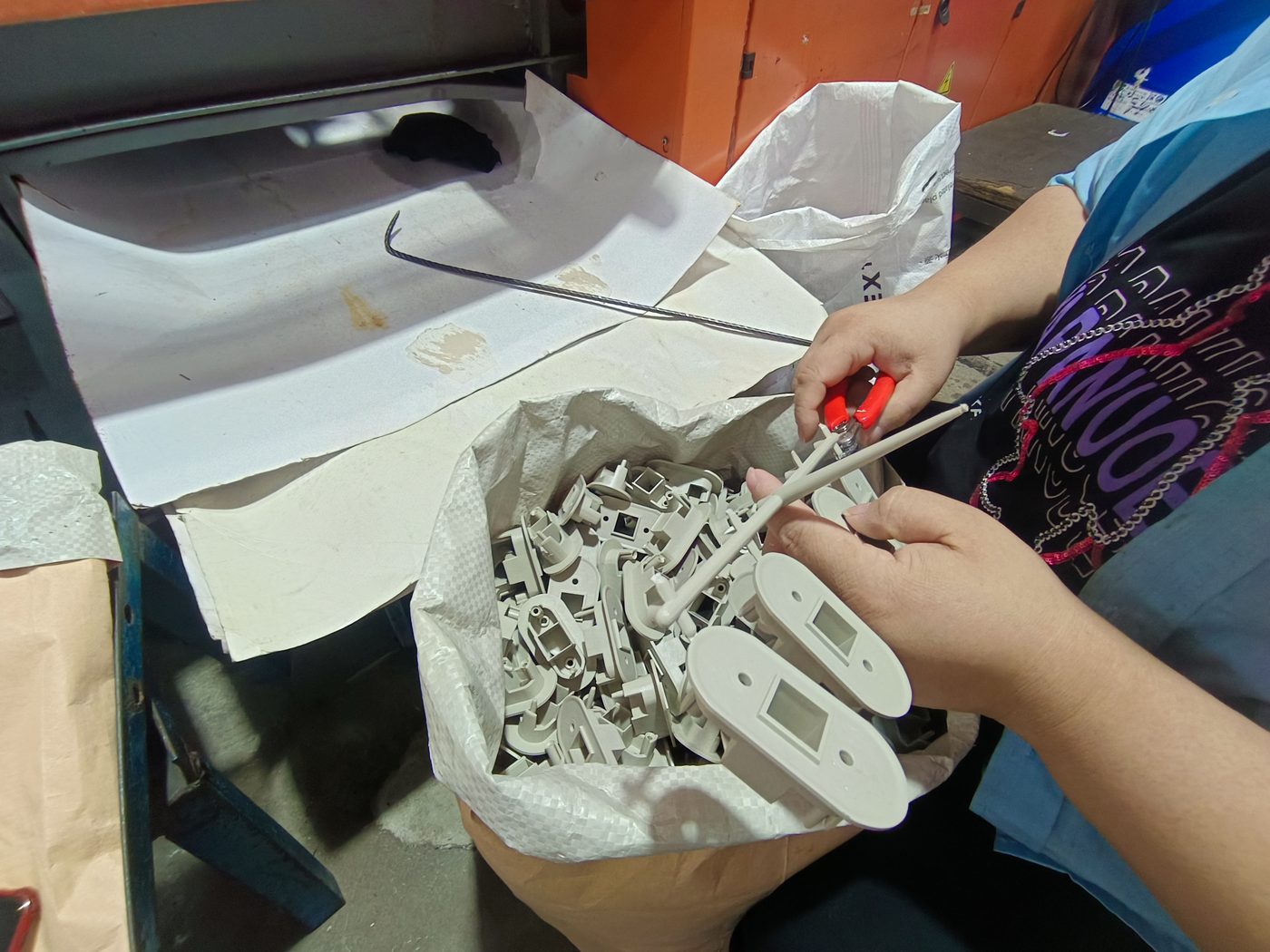
Rigid box assembly is handwork. Corners are turned, wraps are pressed, linings are glued, magnets or hinges are set, ribbon pulls are threaded. A skilled worker on a straightforward lid-and-base box is quick; the same worker on a double-door box with a tray, a mirror, and two ribbon pulls is not.
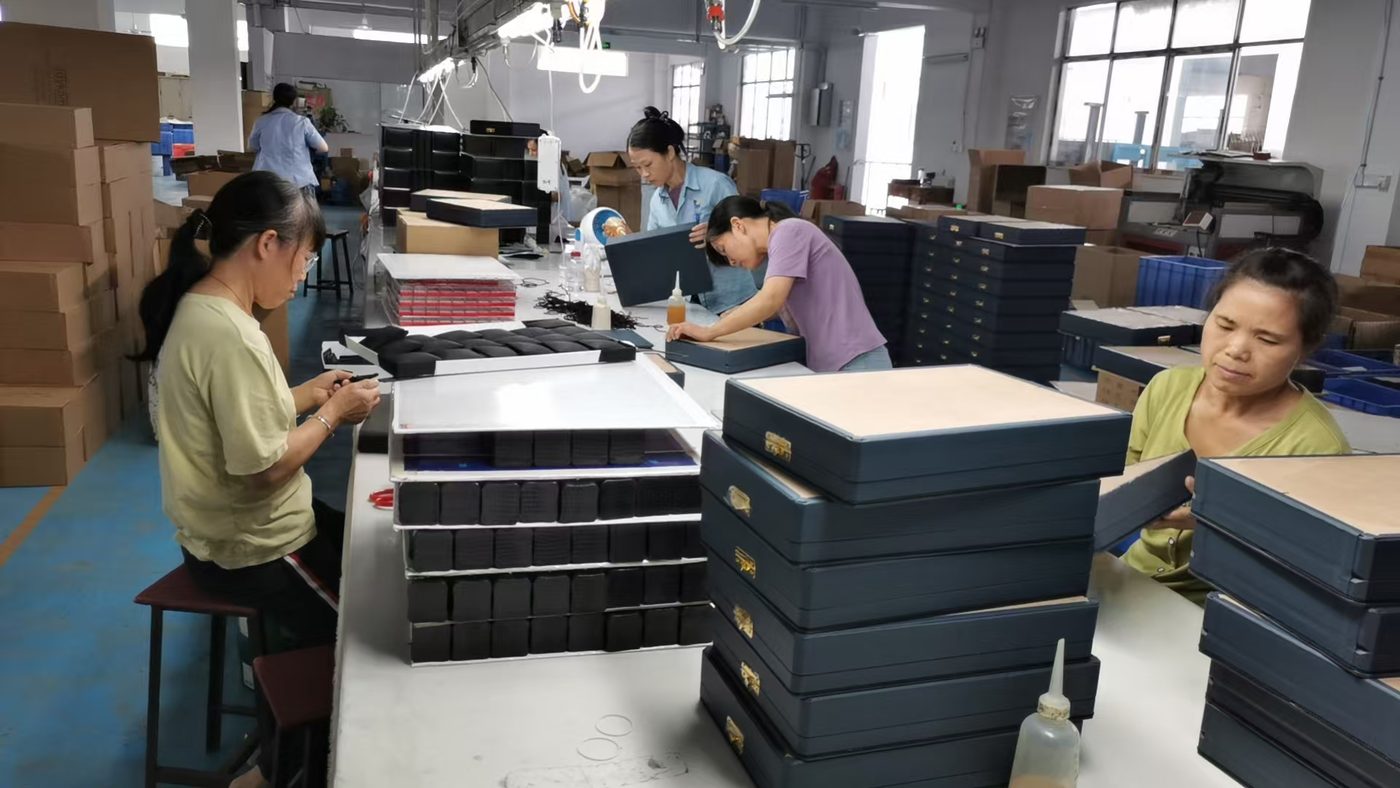
Then packing. Retail-ready packing means each box goes into a polybag, then into an inner carton, then an export carton, with tissue or corner protectors. It costs money per unit and it protects the thing you already paid for. We have seen buyers remove the corner protectors to save four cents and lose 6% of the shipment to bruised corners.
Freight sits outside the unit price but belongs in the comparison. A box that nests efficiently can cut container cost by a third compared with a design that doesn’t, and that saving often exceeds the difference in unit price. If you are comparing landed cost rather than FOB price, nesting matters as much as material.
The quantity curve is not linear
Buyers often assume price falls smoothly as volume rises. It doesn’t. What actually happens:
Material cost per unit barely moves. Suppliers give volume breaks, but the curve flattens quickly. Going from 3,000 to 10,000 might save 6% on material.
Decoration cost per unit moves modestly. Setup is already amortized by 3,000, so further volume only helps through ink and foil yield.
Insert and assembly labor per unit does not move at all. This is the hard floor.
Tooling amortization collapses. This is where the dramatic savings live, and they are exhausted by around 3,000–5,000 pieces.
The practical break points, in our experience:
- Below 500 — tooling dominates. Consider existing molds and stock sizes rather than a fully custom structure. Our 1,000+ in-house molds exist precisely for this stage.
- 1,000–2,000 — custom structure becomes viable. This is where most brand launches land.
- 3,000–5,000 — tooling is largely irrelevant to unit cost. Optimization should shift to material and carton efficiency.
- Above 10,000 — the conversation changes entirely: dedicated production runs, material pre-booking, and negotiated freight.
Same box, three specs: a worked comparison
This is the clearest way to see where money goes. Three versions of one 200 × 150 × 60 mm jewelry box, all at 3,000 pieces, same shape and same cavity layout.
| – | Spec A — entry retail | Spec B — mid-premium | Spec C — high jewelry |
|---|---|---|---|
| Board | 1.5 mm, 800 g/m² | 2.0 mm, 1,000 g/m² | 2.5 mm, 1,200 g/m² |
| Outer | Matte art paper, printed | PU leatherette | Piano lacquer wood lid, suede body |
| Logo | One-colour screen print | Hot foil + debossed border | Metal plate + foil on lid interior |
| Lining | Flocked paper | Velvet | Suede |
| Insert | Die-cut EVA, flocked | Die-cut EVA, velvet-wrapped | Hand-wrapped suede over board |
| Closure | Friction lid | Concealed magnets | Brass hinge + clasp |
| Relative unit cost | 100 | 168 | 310 |
Spec C is not three times the box. It is roughly three times the number of operations, plus the reject rate that comes with them — lacquer runs show every dust particle, hand-wrapped suede shows every glue line, and both are rejected at a higher rate than printed paper.
That is also why the gap between A and B is smaller than the gap between B and C. Moving from paper to leatherette changes the material and one decoration pass. Moving from leatherette to lacquered wood changes the material, the assembly method, the QC standard, and the packing method.
Five things that quietly add 20–40%
These never appear on a drawing, and they are the most common reason a reorder costs more than the first order.
Splitting one order into colourways. 3,000 pieces across three colours means three setups, three material runs, and three sets of minimums — priced like three orders of 1,000, because that is what they are.
Mixed sizes in one purchase order. Each size needs its own cutting die and its own line time. A “set” of four sizes at 3,000 total is closer in cost to four small orders than to one large one.
Rush lead time. Compressed schedules mean overtime, air freight, or bumping another customer. All three cost money, and all three raise the defect rate.
Artwork that isn’t finished at sampling. Every additional sample round consumes setup labor that was already priced in once. Three rounds instead of one can add more to the total than the box itself.
Retail-ready extras. Belly bands, tissue, silica, polybags, corner protectors, and individual inner cartons are all real costs. Individually small, collectively 20–30% on top of the box.
How to compare two quotes without getting fooled
Ask both suppliers for the same six lines. A quote that won’t show them isn’t cheaper — it’s just less specific.
- Board thickness and density, stated in g/m², not just mm.
- Wrap material with a reference number, not a generic name like “leather-look”.
- Decoration passes itemized — how many, in what order.
- Insert construction and whether it is die-cut or hand-wrapped.
- Tooling: included, separate, or amortized. And who owns it.
- Packing spec and carton dimensions, so you can compare freight.
The single question that exposes most cheap quotes: “What is the board density, and what is the wrap material’s reference number?” A supplier who can’t answer has either not specified it or is hoping you won’t.
When the higher quote is the cheaper box
Unit price is one number. Cost of ownership is several.
A box that arrives with 3% corner bruising costs you the replacement, the freight both ways, and the launch delay. A leatherette that peels in a humid market costs you the entire program’s reputation — we covered that failure mode and how to prevent it in leather boxes in tropical climates. A box that can’t be reordered at the same colour costs you a rebrand.
The relevant comparison is cost per usable, on-time, on-spec unit. Most buyers discover this after their second shipment, which is an expensive way to learn it.
Frequently asked questions
How much does a custom jewelry box cost per unit?
There is no useful single number, but there are useful ranges. A printed paper-wrapped rigid box at 3,000 pieces typically lands in the low single-digit dollars. A PU leatherette box with a wrapped insert runs meaningfully higher. A lacquered wood box with metal hardware sits at several times the paper version. The variables that move the number most are, in order: outer material, insert construction, number of decoration passes, and order quantity.
Is 500 pieces enough to get a custom box made?
Yes, and it is where most brands start. The trade-off is that tooling dominates the unit price at that volume — you may pay $1.20 per unit in amortized setup alone. Two ways to soften it: build on an existing mold rather than a fully new structure, or accept a shared structure with custom decoration. Both are standard practice, and both are worth asking about before you redesign anything.
Why did my second order cost more than my first?
Almost always one of four reasons: the first order’s tooling was waived as an introductory concession and is now billed; material prices moved; the first order was packed more simply; or the artwork changed slightly and triggered a new setup. Ask for the two quotations side by side by line item — the difference is always visible once it’s itemized.
Does a higher price mean better quality?
No. Price correlates with specification, and specification only correlates with quality if it was specified deliberately. A $2.00 box with thin wrap and a hand-wrapped insert is worse value than a $1.60 box with dense board and a die-cut insert. The way to know is to inspect the sample against a written standard rather than a feeling — our factory inspection standards for odor, peeling, and bubbling is a usable starting checklist.
What is the fastest way to cut unit cost without changing how the box looks?
Three moves, in order of impact: reduce the number of decoration passes, switch a hand-wrapped insert to a die-cut one, and add a second size or colourway into the same order instead of running separate ones. None of them change the box a customer sees. All of them change the price.
If you want a real number
Send us a drawing or a reference photo, the dimensions, the quantity, and the market you’re selling into. We’ll come back with a quotation that itemizes the five layers above, so you can see exactly which part of the specification is driving the price — and decide whether it’s worth paying for.